
 NEWS
NEWS
Brussels Meeting Reviews Progress in Implementing the Outcomes of the EU-Central Asia Summit
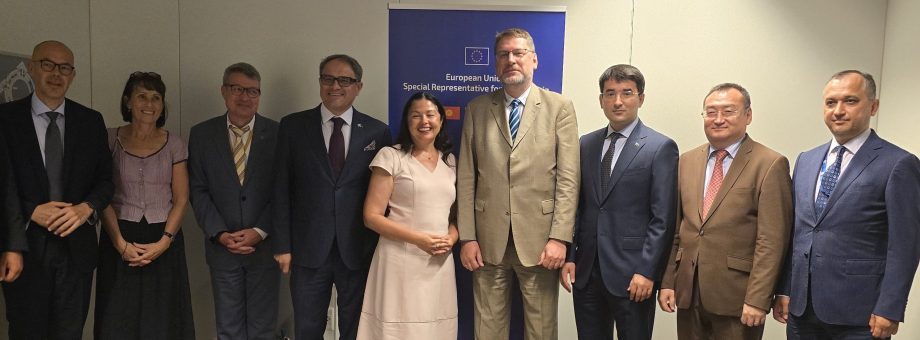
A regular joint meeting of the Ambassadors of the Central Asian countries with senior representatives of the European Union institutions was held at the European External Action Service (EEAS) in Brussels.
The European side was represented by Deputy Managing Director for Eastern Europe and Central Asia at the EEAS, Ms. Audrone Perkauskiene, EU Special Representative for Central Asia Mr. Eduards Stiprais, Director for Asia, Central Asia, Middle East/Gulf and Pacific at the European Commission's Directorate-General for International Partnerships (DG INTPA) Mr. Peteris Ustubs, Head of the Central Asia Division at the EEAS Mr. Dietmar Krissler, Head of the Central Asia and Afghanistan Unit at DG INTPA Ms. Charlotte Adriaen, together with officials from the relevant EU institutions.
The meeting reviewed progress in implementing the outcomes of the first European Union-Central Asia Summit and discussed the next phase of interregional cooperation. Particular attention was devoted to preparations for upcoming high-level political events, transport connectivity, security, trade and investment, digital transformation, energy cooperation, and people-to-people contacts.
The European Union confirmed that the next Ministerial Meeting on Connectivity and Security involving the countries of Central Asia, the Eastern Partnership and the Black Sea region will take place on 16 November 2026. The participants also discussed preparations for the Second EU-Central Asia Summit, scheduled for 2027.
Participants welcomed the successful launch of the Connectivity Agenda Platform in Brussels on 23 June 2026, highlighting its importance as an additional mechanism for advancing the Trans-Caspian Transport Corridor and strengthening regional connectivity between Central Asia and Europe. The discussion emphasized the growing importance of digitalization of transport procedures, customs modernization, and the removal of non-physical barriers to cross-border trade.
The European side reaffirmed its commitment to implementing the Global Gateway investment agenda, including continued cooperation with the European Investment Bank, the European Bank for Reconstruction and Development and other international financial institutions. Preparations are also underway for the Global Gateway Forum, which will take place in Brussels on 7-8 June 2027.
Particular attention was given to further strengthening the legal framework of cooperation between Turkmenistan and the European Union.
The European side positively acknowledged Turkmenistan's consistent efforts to deepen political dialogue with the European Union and confirmed its readiness to continue joint work on developing a bilateral roadmap aimed at further advancing cooperation.
In his remarks, the Ambassador of Turkmenistan emphasized that cooperation between Central Asia and the European Union is becoming increasingly practical and results-oriented. He noted that summits, ministerial meetings, expert platforms and bilateral consultations should be viewed as elements of a continuous political process focused on delivering tangible outcomes.
The Turkmen side also underlined the importance of the Connectivity Agenda Platform as an effective mechanism for promoting regional transport cooperation and stressed the need to further strengthen coordination mechanisms and enhance the resilience of regional transport corridors.
The meeting also explored opportunities to expand cooperation with European financial institutions, implement new infrastructure projects, deepen collaboration in the field of critical raw materials, promote digital transformation, strengthen energy cooperation, and further develop partnerships in education, counter-terrorism and other areas of shared interest.
At the conclusion of the meeting, both sides reaffirmed their commitment to further strengthening the strategic partnership between the European Union and Central Asia through regular political dialogue and the practical implementation of joint initiatives aimed at promoting sustainable development, regional connectivity and long-term economic growth.