
 NEWS
NEWS
Meeting at the Directorate-General of the European Commission for Climate Action (DG CLIMA)
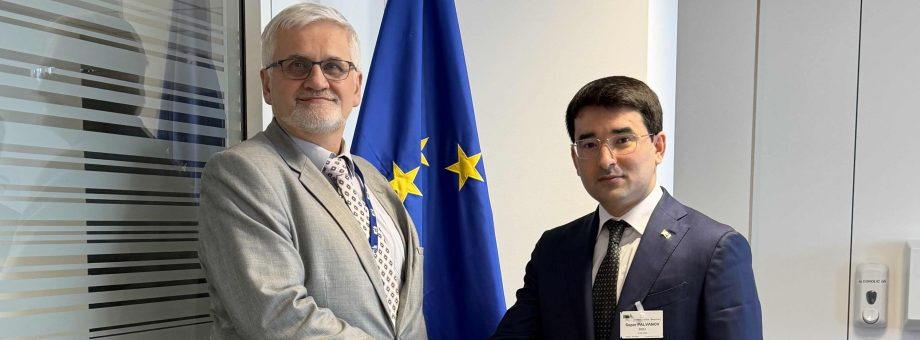
A constructive and substantive meeting was held in Brussels between the Ambassador of Turkmenistan, Sapar Palvanov, and Jan Dusik, Deputy Director-General of the European Commission’s Directorate-General for Climate Action.
The Turkmen diplomat emphasized that the European direction is among the three key priorities of Turkmenistan’s foreign policy roadmap for 2026. Climate and energy issues are viewed as one of the central pillars for giving practical substance to bilateral cooperation with the European Union.
The Ambassador underlined that Turkmenistan, as a producer of natural resources, is fully aware of its environmental responsibilities and the need to move towards cleaner energy solutions. In this context, he highlighted Turkmenistan’s accession to the Global Methane Pledge, announced at COP28, as well as the country’s participation in the Paris Agreement. These commitments provide a solid political foundation for deepening cooperation with the EU in methane emission reduction, climate adaptation, and environmental modernization.
Particular attention was given to the ongoing programme “EU for a Green Turkmenistan: Policy Dialogue and Climate Action 2024–2028,” implemented with European support and German partners. The Ambassador stressed its practical orientation and the tangible results already achieved, including methane monitoring efforts and environmental awareness initiatives.
Both sides agreed on the importance of advancing cooperation through concrete projects, expert exchanges, and existing regional formats between the EU and Central Asia. It was noted that climate policy remains a strategic priority for the European Union, including long-term emission reduction objectives and the development of carbon removal instruments.
The Ambassador also outlined forward-looking areas of cooperation that are gaining prominence in the regional agenda, such as water resource management, climate adaptation, issues related to the Caspian Sea level decline, and the exchange of advanced environmental technologies. In this regard, he recalled Turkmenistan’s initiative to establish a Regional Center for Environmental Technologies in Central Asia.
Special interest was expressed in the potential for solar energy development and cross-border energy infrastructure. The European side positively assessed Turkmenistan’s potential in the context of the growing demand for clean electricity.
They confirmed that the strengthening of the EU–Central Asia strategic partnership should be accompanied by an expansion of substantive bilateral cooperation between Turkmenistan and the European Union.